Xiaomi Redmi Note 15 Pro+
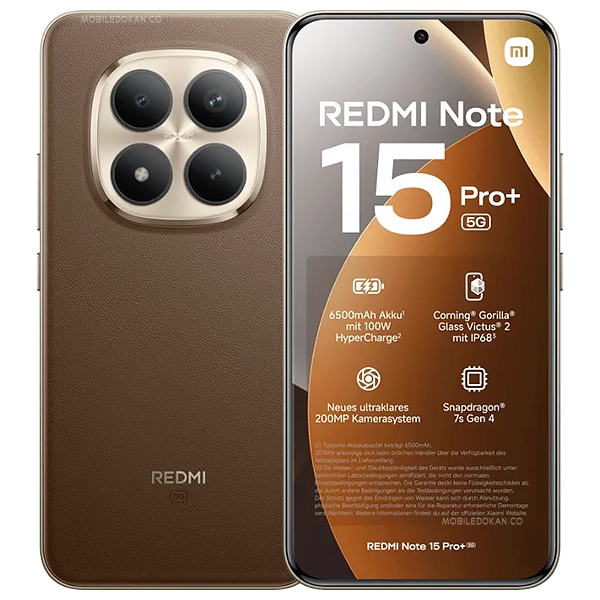
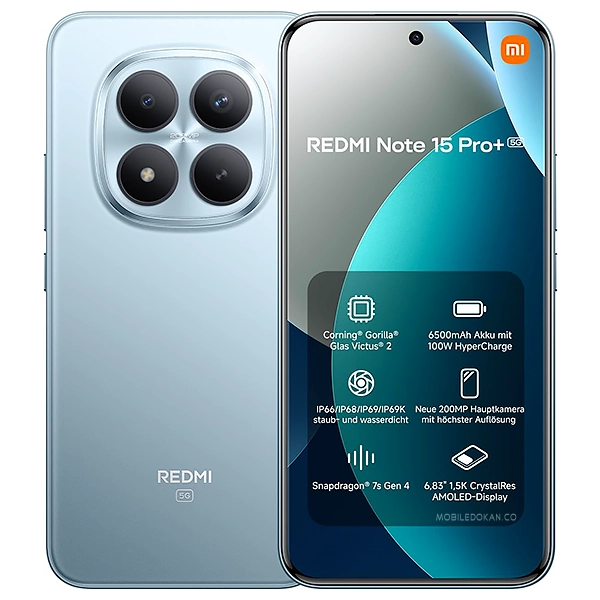
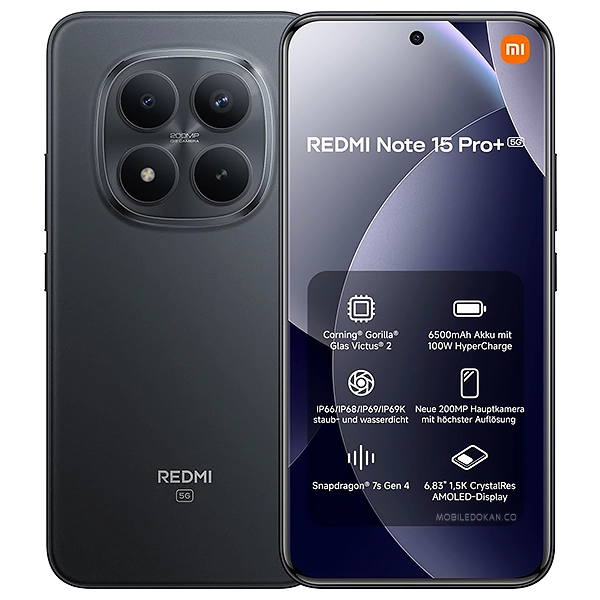

Pro and cons
Pros
- 6.83-inch AMOLED display, 120Hz refresh.
- Snapdragon 7s Gen 4 chipset with 8/12GB RAM.
- Dual rear camera with 200MP, 32MP selfie.
- Stereo speakers, Infrared port, Fingerprint.
- 6500mAh battery with 100W charging.
Cons
- Plastic frame body
Prices
- 8GB 256GB৳46,999 +VATOfficial
- 12GB 512GB৳59,999 +VATOfficial
- 12GB 256GB (CN)৳36,000Unofficial
Also available Xiaomi Redmi Note 15 Pro+ China version
Specifications
General
| Brand | Xiaomi |
| Model | Redmi Note 15 Pro+ |
| Device | Smartphones |
| Added | December 3, 2025 |
| Updated | May 10, 2026 |
Launch
Announced | 2025, December 18 |
Status | Available. Released 2025, December 25 |
Network
Technology | GSM / HSPA / LTE / 5G |
2G bands | GSM 850 / 900 / 1800 / 1900 |
3G bands | HSDPA 800 / 850 / 900 / 1700(AWS) / 1900 / 2100 |
4G bands | 1, 2, 3, 4, 5, 7, 8, 12, 13, 17, 18, 19, 20, 26, 28, 32, 38, 40, 41, 42, 48, 66, 71 |
5G bands | 1, 2, 3, 5, 7, 8, 12, 20, 26, 28, 38, 40, 41, 48, 66, 71, 77, 78 SA/NSA |
Speed | HSPA, LTE, 5G |
Body
Dimensions | 163.3 x 78.3 x 7.9 mm (6.43 x 3.08 x 0.31 in) |
Weight | 207 g (7.30 oz) |
Build | Glass front (Gorilla Glass Victus 2), glass back (Gorrila Glass 7i) or silicone polymer back (eco leather), aluminum frame |
SIM | Nano-SIM + eSIM Nano-SIM + Nano-SIM |
Others | IP68/IP69K dust tight and water resistant (high pressure water jets; immersible up to 1.5m for 30 min) Manufacturer-rated water-resistance (up to 2m for 24 hours) Drop resistant up to 2.5m |
Display
Type | AMOLED, 68B colors, 120Hz, 3840Hz PWM, HDR10+, Dolby Vision, 3200 nits (peak) |
Size | 6.83 inches, 114.5 cm2 (~89.6% screen-to-body ratio) |
Resolution | 1280 x 2772 pixels, 19.5:9 ratio (~447 ppi density) |
Protection | Corning Gorilla Glass Victus 2, Mohs level 5 |
Platform
OS | Android 15, up to 4 major Android upgrades, HyperOS 2 |
Chipset | Qualcomm SM7635-AC Snapdragon 7s Gen 4 (4 nm) |
CPU | Octa-core (1x2.7 GHz Cortex-A720 & 3x2.4 GHz Cortex-A720 & 4x1.8 GHz Cortex-A520) |
GPU | Adreno 810 |
Memory
Card slot | No |
Internal | 256/ 512 GB |
RAM | 8/12 GB |
Variant | 8GB 256GB / 12GB 256GB / 12GB 512GB |
Main camera
Dual | 200 MP, f/1.7, 23mm (wide), 1/1.4", 0.56µm, multi-directional PDAF, OIS 8 MP, f/2.2, 15mm, 120˚ (ultrawide), 1/4.0", 1.12µm |
Features | LED flash, HDR, panorama |
Video | 4K@24/30fps, 1080p@30/60/120fps, gyro-EIS, OIS |
Selfie camera
Single | 32 MP, f/2.2, (wide), 1/3.0", 0.7µm |
Features | HDR, panorama |
Video | 1080p@30/60fps |
Sound
Loudspeaker | Yes, with stereo speakers (with Dolby Atmos) |
3.5mm jack | No 24-bit/192kHz Hi-Res & Hi-Res wireless audio |
Connectivity
WLAN | Wi-Fi 802.11 a/b/g/n/ac/6/6e, dual-band, Wi-Fi Direct (/6e is market/region dependent) |
Bluetooth | 5.4, A2DP, LE |
GPS | GPS (L1+L5), GALILEO, GLONASS, QZSS, BDS |
NFC | Yes (market/region dependent) |
FM radio | Unspecified |
USB | USB Type-C 2.0, OTG |
Infrared port |
Features
Sensors | Fingerprint (under display, optical), accelerometer, gyro, compass, proximity |
Battery
Type | Non-removable Si/C Li-Ion |
Capacity | 6500 mAh |
Charging | 100W wired, 100% in 40 min 22.5W reverse wired |
More
Made by | China |
Color | Glacier Blue, Mocha Brown, Black |
Models | 2510ERA8BG |
Disclaimer
We do not guarantee that the information of this page is 100% accurate and up to date. Read more about our full disclaimer
Xiaomi Redmi Note 15 Pro+ Price in Bangladesh September 2026
The Xiaomi Redmi Note 15 Pro+ has now available in a variants (256/512GB/8/12GB ROM/RAM). Now, the Xiaomi Redmi Note 15 Pro+’s Price is 46999 Taka in Bangladesh. Redmi Note 15 Pro+ has a 6500mAh battery that is 100W fast charging. This device runs Android 15 and is powered by the Qualcomm SM7635-AC Snapdragon 7s Gen 4 (4 nm) chipset.
| Model | Xiaomi Redmi Note 15 Pro+ |
| Price | BDT. 46,999 |
| Display | 6.83″ 1280×2772 pixels |
| RAM | 8/12 GB |
| ROM | 256/512 GB |
| Released | 2025, December |
Xiaomi Redmi Note 15 Pro+ highlights
Xiaomi Redmi Note 15 Pro+ will be launched in December 2025. The Redmi Note 15 Pro+ was launched with model number 2510ERA8BG. Firstly, its dimensions are 163.34 x 78.31 x 7.91 mm, and its weight is 207 grams. Secondly, the Redmi Note 15 Pro+ display is a 6.83-inch AMOLED panel with a 1280 x 2772-pixel resolution. The display is protected with Corning Gorilla Glass. Thirdly and most importantly, it is powered by the Qualcomm SM7635-AC Snapdragon 7s Gen 4 (4 nm) and runs on Android 15. Moreover, it has an Octa-core (1×2.7 GHz Cortex-A720 & 3×2.4 GHz Cortex-A720 & 4×1.8 GHz Cortex-A520) CPU.
Xiaomi Redmi Note 15 Pro+ phone has a dual-camera setup on the back. This formation consists of a 200MP wide, 8MP camera. It has a 32MP selfie camera in the display’s punch hole. The video recording capability is 4K@24/30fps, 1080p@30/60/120fps, gyro-EIS, OIS. Its RAM and ROM have two (256/512GB/8/12GB) variants. On the other hand, it can not support a microSDXC card. Certainly, the Redmi Note 15 Pro+ has a 6500mAh battery that supports fast charging. It has a dual nano-SIM card slot. That is to say, the Redmi Note 15 Pro+ supports 2G/3G/4 G/5G.
On the other hand, it has WLAN, Bluetooth, a USB port, and Face unlock, among other features.
Your question and our opinion about the Note 15 Pro Plus 5G
What question will you have about this phone? Let’s justify these. We are including the major questions and answers about this phone. So, let’s start now.
It will launch in December 2025.
The price of the Xiaomi Redmi Note 15 Pro+ is BDT. 46,999.
It has two variants with 8/12GB of RAM and two with 256/512GB of ROM. Overall, there are three variants (256GB/8GB, 256GB/12GB, 512GB/12GB) on the market.
It has a 6.83″ OLED Display panel with 1280 x 2772 pixels resolution.
It contains the Qualcomm SM7635-AC Snapdragon 7s Gen 4 (4 nm) chipset and Android 15. It can have up to an Octa-core (1×2.7 GHz Cortex-A720 & 3×2.4 GHz Cortex-A720 & 4×1.8 GHz Cortex-A520) CPU.
The back has a dual-camera setup: 200MP+8MP and a 32MP selfie camera. The video recording capability is 4K@24/30fps, 1080p@30/60/120fps, gyro-EIS, OIS.
It supports a 5G network with 2G / 3G / 4G.
The battery capacity is 6500 mAh, with 100W fast charging.
Fingerprint, accelerometer, gyro, proximity, and compass sensors
Xiaomi manufactured it and this phone is made in China.
Reason to Buy
In this paragraph, we will describe why people buy this smartphone. Why did a person buy this smartphone? Firstly, when anyone wants to buy a device, they look for premium features according to price. So, let’s explore some key features of the Redmi Note 15 Pro Plus 5G Global version.
Our Verdict
In conclusion, we are giving our verdict on this device. If you want to buy the best 5G smartphone under 80K Taka. Then, the Xiaomi Redmi Note 15 Pro+ will be in the first row among the best smartphones. Dear friends, if you are interested in online games like Free Fire, you can buy them, as they have 8/12GB RAM and a good processor powered by the Qualcomm SM7635-AC Snapdragon 7s Gen 4. If you want a big backup charge, you can buy this because it has a 6500 mAh battery. In addition, it’s a 5G supportable smartphone. So, you can get good network facilities on it. However, it has a dual-camera setup with a 200MP primary camera. So, the image and video capabilities may be good.
Reviews/comments

Prices and specifications
Ja dicche athe price 45,000± howa uchit chilo.karon 45K-50K taka te ar theke 3x 4x better performance ar flagship smartphones dicche other brands. Ami redmi note series lover chilam note 12 obdi. Note 11 ar por theke khali camera megapixel only bartase photo video quality ar bartase na 😢.